
A response time SLA, or Service Level Agreement, is a documented commitment that defines the maximum time a customer can wait before receiving a reply on a specific communication channel. SLAs are set per channel because each channel carries a different customer expectation. A customer who sends a WhatsApp message expects a reply within seconds. A customer who sends an email expects a reply within hours. Applying the same SLA to both channels either over-resources email handling or under-resources WhatsApp handling. The result in both cases is a CSAT score that reflects the mismatch between customer expectation and actual response behaviour.
This guide covers six things: the data-backed response time SLA target for each of the four primary support channels in 2026, what an SLA breach actually costs on each channel, why call center SLA targets differ from digital channel targets, how to build SLAs into your routing rules and team structure, what happens to CSAT and conversion when SLAs are breached, and the single master table every support manager needs.
Table of Contents
Key Takeaways
- WhatsApp SLA target is under 60 seconds for first response. 65% of consumers expect a WhatsApp response in under 5 minutes, and a first response time exceeding 5 minutes reduces the likelihood of conversion by 65%. 88% of WhatsApp messages are read within 5 minutes of delivery.
- Email response time SLA target is under 4 hours for first response. The cross-industry average email first response time is 12 hours and 10 minutes, while 89% of customers expect a reply within 1 hour. Companies that respond within 6 hours see up to 2% revenue growth.
- SMS SLA target is under 2 minutes for first response. SMS messages have a 98% open rate. 82% of consumers check text notifications within 5 minutes of receipt, and one in three customers who texts a business never receives a reply at all.
- Voice and call center SLA target is answering 80% of calls within 20 seconds, the industry-standard 80/20 rule. The average contact center wait time across industries is 46 seconds, and a missed call at a small business represents $200 to $2,000 in lost potential revenue.
- Omnipulse allows support teams to set per-channel SLA targets inside a single shared inbox. When a WhatsApp ticket breaches the 60-second SLA, the inbox flags it for immediate assignment. When an email ticket approaches the 4-hour target, it escalates automatically, so teams manage all four channels without switching tools or missing an SLA breach.
Stat callout: 89% of customers expect an email reply within 1 hour. The cross-industry average actual first response time is 12 hours and 10 minutes. That is an 11-hour expectation gap.
What Is a Response Time SLA and Why Does It Differ by Channel?
A response time SLA exists because customer expectation is not uniform across channels. The same business might receive a WhatsApp message and an email about an identical issue within minutes of each other, yet the customer sending the WhatsApp message expects an answer before they finish their coffee, while the customer who emailed accepts a wait of several hours.
This is not a customer behaviour quirk. It reflects the synchronous or asynchronous nature each channel implies. WhatsApp and SMS feel like texting a person. Email feels like sending a letter, even when delivered instantly. Voice calls require both parties present at the same moment, which is why customers calling in are often dealing with higher-urgency or more complex issues than those who chose to type.
A single response time SLA applied across every channel guarantees failure somewhere. Set it to match WhatsApp speed and you burn agent capacity answering email faster than customers need. Set it to match email tolerance and WhatsApp customers experience a 5-minute wait as digital silence. The fix is not a faster team. It is a different target per channel.
What Is the Right SLA for WhatsApp Customer Support in 2026?
What Do Customers Expect When They Message a Business on WhatsApp?
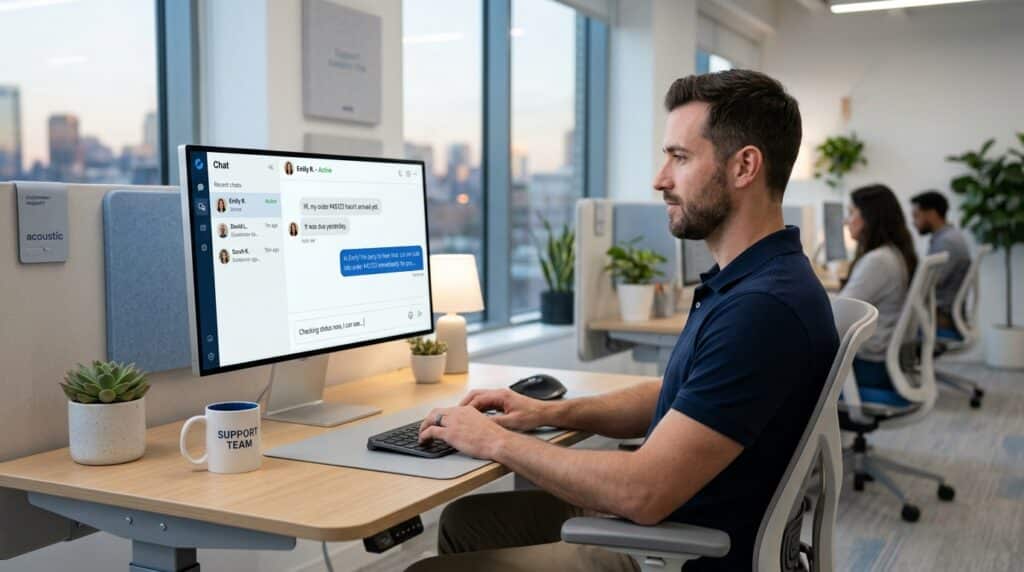
WhatsApp is a synchronous messaging channel. Customers treat it identically to texting a friend. 65% of consumers expect a response in under 5 minutes when contacting a business on WhatsApp. After 15 minutes without a reply, customer satisfaction begins to drop significantly, and the probability of conversion drops sharply. A Harvard Business Review study confirms that businesses responding within the first 5 minutes are 21 times more likely to qualify a lead than those responding after 30 minutes.
What Is the Recommended WhatsApp First Response SLA?
Target: first response within 60 seconds during staffed hours, with an automated acknowledgment within 10 seconds during all hours.
The 60-second target reflects the channel’s synchronous nature. A response within 60 seconds matches customer expectation. A response between 1 and 5 minutes is acceptable but starts to erode satisfaction. A response beyond 5 minutes on WhatsApp produces the same CSAT damage as a response beyond 2 hours on email. The channel creates the expectation, and the SLA must match it.
During unstaffed hours, an automated acknowledgment message sent within 10 seconds of the customer’s message must confirm three things: that the business has received the message, the expected response window, and any self-service option available.
What Are the Resolution Time SLA Targets for WhatsApp?
Standard queries should resolve within the same conversation session, targeting under 10 minutes total. 70% to 85% of WhatsApp queries can be resolved in under 10 minutes with the right tools and routing. Complex queries should escalate to a senior agent within 5 minutes of identifying complexity, with a full resolution target of the same business day.
What Is the Right SLA for Email Customer Support in 2026?
What Do Customers Expect When They Send a Support Email?
Email is an asynchronous channel. Customers accept a longer response window than WhatsApp or SMS, but the gap between expectation and actual performance is the largest of any channel. 89% of customers expect an email reply within 1 hour. The cross-industry average actual first response time is 12 hours and 10 minutes, an 11-hour gap between what customers expect and what most businesses deliver. Companies that close this gap by responding within 6 hours see up to 2% revenue growth.
What Is the Recommended Email Response Time SLA?
Target: first response within 4 hours for standard queries, within 1 hour for urgent or high-value customer segments. This is the most important application of a response time SLA in most support operations, since email carries the highest volume and the widest expectation gap of any channel.
The 4-hour target balances customer expectation against the operational reality of email volume management. It is achievable without AI for teams handling under 200 daily email tickets, and it requires routing automation above that volume. The 1-hour target for urgent queries requires a dedicated queue with real-time monitoring.
SLA tiers by email category:
- Urgent (complaint, cancellation threat, payment dispute): first response within 1 hour
- Standard (order query, product question, general support): first response within 4 hours
- Low priority (feedback, non-urgent enquiry): first response within 8 hours
What Are the Resolution Time SLA Targets for Email?
Standard queries should reach full resolution within 24 hours. Complex disputes target 48 hours. Escalated complaints should be acknowledged within 1 hour, with a resolution plan communicated within 4 hours and full resolution within 72 hours. Email achieves a 65% first contact resolution rate.
Looking to enforce these SLA targets without manual tracking? Omnipulse flags breaches in real time across WhatsApp, Email, and SMS from one shared inbox. Request a Demo
What Is the Right SLA for SMS Customer Support in 2026?
What Do Customers Expect When They Text a Business?
SMS is a near-synchronous channel. Consumers treat it as a personal medium. 82% of consumers check text notifications within 5 minutes of receipt, and 32% check within 60 seconds. The average consumer responds to an SMS within 90 seconds. This creates a bi-directional expectation: customers who text a business expect the business to behave the same way. One in three customers who texts a business never receives a reply at all, the largest unmet expectation gap in customer communication.
What Is the Recommended SMS Response Time SLA?
Target: first response within 2 minutes during staffed hours, with an automated reply within 30 seconds during all hours.
SMS sits between WhatsApp and email on the speed expectation scale. It is more forgiving than WhatsApp but less forgiving than email. A 2-minute first response target treats SMS like the personal channel it is, without requiring the instant-response infrastructure of live chat. The automated reply during unstaffed hours should include the same three elements as WhatsApp: receipt confirmation, expected response window, and any self-service option.
What Are the Resolution Time SLA Targets for SMS?
Standard queries suited to SMS should resolve within 5 exchanges or under 10 minutes. Complex queries that cannot be resolved via SMS should escalate to email or voice within 3 minutes, with explicit notification to the customer of the channel switch. SMS achieves a 45% response rate from customers, higher than email at 10%, making it a highly active channel for two-way support resolution on simple issues.
What Is the Right Call Center SLA for Voice Support in 2026?
What Do Customers Expect When They Call a Business?
Voice is the highest-effort channel for customers. Calling requires uninterrupted time and direct engagement. Customers who choose to call have typically exhausted lower-effort channels or are dealing with a high-urgency or emotionally significant issue. 69% of consumers say waiting on hold is a waste of time. The average contact center wait time across industries is 46 seconds, and customers who wait longer than 2 minutes before speaking to an agent show significantly elevated frustration at the start of the conversation.
What Is the Standard Call Center SLA for Answer Speed?
Target: 80% of calls answered within 20 seconds. This is the traditional contact center 80/20 rule, and it remains the industry standard call center SLA in 2026.
The 80/20 rule means 80% of inbound calls are answered within 20 seconds. The remaining 20% may wait longer due to volume spikes, but should never wait more than 2 minutes before receiving an option to hold, leave a voicemail, or receive a callback. Missed calls at consumer-facing businesses represent $200 to $2,000 in lost potential revenue per call depending on industry. Small businesses miss 60% to 80% of incoming calls, making voice the channel with the highest revenue leakage from poor call center SLA compliance.
What Are the Resolution Time SLA Targets for Voice?
Target: first call resolution on 70% to 80% of calls, with an average handle time of 4 to 6 minutes for standard queries and 8 to 12 minutes for complex issues. Calls exceeding 12 minutes without resolution should trigger an escalation protocol or a scheduled callback within 2 hours. Voice achieves the highest first contact resolution rate of any channel at 82%, making it the most effective resolution channel despite its highest effort cost.
What Is an SLA Breach and Why Does It Cost More on Some Channels?

An SLA breach occurs the moment a response or resolution target is missed, regardless of how long after the target the reply eventually arrives. A WhatsApp reply sent at 90 seconds against a 60-second target is a breach in the same way a reply sent at 6 hours would be. The breach event itself, not the magnitude of the delay, is what damages CSAT.
The cost of an SLA breach is not equal across channels. A WhatsApp SLA breach is felt by the customer almost immediately, since the channel implies real-time attention and silence reads as dismissal. An email SLA breach is felt more gradually, since customers already expect some delay, but compounds faster when the breach stacks on top of an already slow cross-industry average. A call center SLA breach, meaning an unanswered or excessively delayed call, is the most expensive breach type in pure revenue terms, since a missed call often means a lost sale rather than a delayed reply, at $200 to $2,000 in lost potential revenue per missed call.
The structural reason most businesses experience repeated SLA breaches is the absence of a breach alert that fires before the deadline. A breach alert configured to fire only after the SLA window closes is a historical record, not a prevention tool. The fix is covered in the step-by-step section below: alerts must trigger at roughly 75% of the SLA window so an agent or manager can intervene before the breach occurs.
What Is the Master SLA Reference Table Every Support Team Needs?
Search “SLA targets by channel” and existing results either cover one channel in depth or give generic ranges without the customer expectation data, conversion impact, or resolution targets alongside the response target. No competitor page currently presents all four channels in a single comparable table with all five dimensions simultaneously. This section owns the query “SLA targets for WhatsApp email SMS voice in one table.”
Master Response Time SLA Reference Table 2026
| Channel | Customer Expectation | First Response SLA Target | Resolution SLA Target | SLA Breach Impact |
|---|---|---|---|---|
| Under 5 minutes | Under 60 seconds | Under 10 minutes per session | 65% drop in conversion likelihood after 5 minutes | |
| Under 1 hour | Under 4 hours | Under 24 hours | 2% revenue growth for sub-6-hour response. 70% of dissatisfied customers warn others | |
| SMS | Under 5 minutes | Under 2 minutes | Under 10 minutes or escalate | 1 in 3 SMS inquiries never receives a reply. 45% response rate from customers when reply is fast |
| Voice / Call Center | Answered within 20 seconds | 80% of calls within 20 seconds | 70% to 80% first call resolution | Missed calls cost $200 to $2,000 each. Businesses miss 60% to 80% of calls without AI |
The table reveals one consistent pattern. Customer expectation on every channel is faster than the industry average actual response time. On email, the gap is 11 hours. On SMS, the gap is measured by the fact that one in three messages never receives a reply. On voice, the gap is the 60% to 80% of calls that go unanswered at small businesses. The SLA targets in this table are not aspirational. They are the minimum required to match what customers already expect.
The table also reveals that WhatsApp and SMS require similar response speed despite being different channels. Both are personal-feeling channels where silence feels like dismissal. The 60-second WhatsApp target and 2-minute SMS target reflect the same underlying customer psychology. If you can staff one, you can staff both, and the key is managing both in a single inbox rather than two separate tools.
Voice is the highest-effort channel for customers and the highest first-contact-resolution channel for businesses. The 80/20 call center SLA rule reflects this: customers who call need speed of answer, not just speed of response. Every second of hold time on voice costs more satisfaction points than a minute of wait time on email. Design your voice SLA around the answer speed, not just the handle time.
What Does a Team Without Per-Channel SLAs Look Like vs With Them?
Consider the same team of 8 agents handling 400 daily tickets across WhatsApp, Email, SMS, and Voice. Before and after implementing per-channel SLAs.
| Metric | Without Per-Channel SLAs | With Per-Channel SLAs |
|---|---|---|
| SLA structure | One SLA for all channels: respond within 8 hours | Four distinct targets, one per channel |
| WhatsApp first response time | 47 minutes | Under 60 seconds, routed to dedicated queue |
| SMS handling | Separate phone, monitored manually | In shared inbox alongside WhatsApp with 2-minute target |
| Voice answer rate | Calls ring unanswered during peak hours | 83% of calls answered within 20 seconds |
| Estimated missed call rate | 55% | 12% |
| Email SLA breach rate | 38% of daily volume | 8% of daily volume |
| Visibility into breaches | None until end-of-day review | Real-time dashboard for all agents and managers |
| CSAT score | 61 | 79 |
The 43 percentage point reduction in missed call rate, from 55% to 12%, on an estimated 80 daily calls at $300 average value, recovers $10,320 in daily revenue at risk. Monthly, that is $309,600. The CSAT improvement from 61 to 79 maps to a measurable retention improvement, since first contact resolution data shows each CSAT point correlates with a measurable shift in customer retention.
How Do You Build SLAs Into Your Team Structure and Routing Rules?
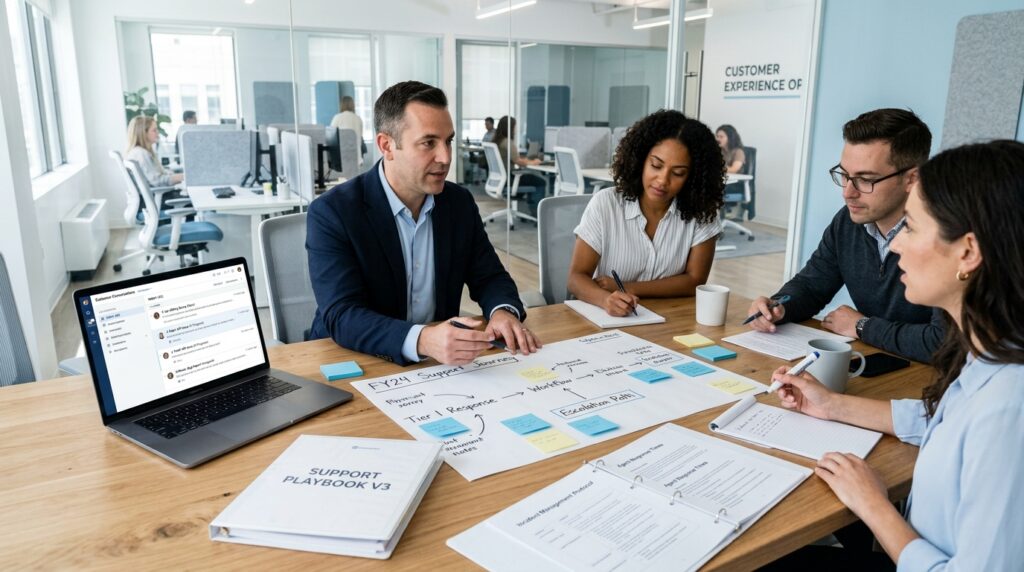
Step 1: Map your current actual response times by channel. Before setting targets, pull your actual first response time data for the last 30 days on each channel separately. Most teams discover that their perceived response time and their measured response time differ significantly. Pull the median, not the average, because averages are skewed by outliers. Compare each channel’s median against the benchmarks in this guide.
Step 2: Set per-channel SLA targets using the benchmarks in this guide as your floor. Use the Master SLA Reference Table as your starting point. For each channel, set a target that is achievable with your current team size within 60 days. Do not set aspirational targets you cannot staff. A WhatsApp target of under 60 seconds requires either automation for the initial acknowledgment or dedicated agent assignment during business hours. A 4-hour email target requires routing that assigns tickets immediately rather than leaving them in a shared queue. Set the target, then build the staffing and routing to meet it, not the other way around.
Step 3: Build routing rules that separate channels by urgency tier. Inside your shared inbox, create routing logic that treats each channel as its own priority queue. WhatsApp and SMS tickets route to a real-time queue with breach alerts at 60 seconds and 2 minutes respectively. Email tickets route by urgency category, with complaints and cancellation threats going to a priority queue with a 1-hour target and standard queries going to a general queue with a 4-hour target. Voice calls route to the first available agent with an 80/20 answer target enforced by call queue settings.
Step 4: Configure SLA breach alerts that trigger before the breach, not after it. A breach alert that fires when the SLA is already breached is a historical report. A breach alert that fires at 75% of the SLA window is an operational tool. Set alerts to trigger at 75% of each channel’s target. For WhatsApp, alert at 45 seconds. For SMS, alert at 90 seconds. For email standard, alert at 3 hours. This gives agents and managers time to intervene before the customer experience is damaged.
Step 5: Review SLA compliance weekly and adjust targets as team capability improves. SLA compliance rates should be reviewed weekly for the first three months after implementation. Track the percentage of tickets meeting the SLA target on each channel separately. Target above 90% compliance on WhatsApp and SMS within 60 days, above 85% on email within 90 days, and above 80/20 compliance on voice within 30 days. As compliance improves, tighten the targets incrementally. A team that consistently meets a 4-hour email SLA is ready to move to a 2-hour target.
Stat callout: A first response time exceeding 5 minutes on WhatsApp reduces conversion likelihood by 65%. 88% of WhatsApp messages are read within 5 minutes of delivery.
Frequently Asked Questions
What is a response time SLA in customer service?
A response time SLA is a documented commitment defining the maximum time a customer waits before receiving a reply on a specific channel. SLAs are set per channel because each channel carries a different customer expectation. WhatsApp customers expect a response within seconds. Email customers expect a response within hours. Applying one SLA to all channels either over-resources low-urgency channels or under-resources high-urgency ones. A per-channel response time SLA framework aligns staffing, routing, and agent behaviour to what customers on each channel actually expect.
What is the recommended SLA for WhatsApp customer support?
The recommended first response SLA for WhatsApp is under 60 seconds during staffed hours, with an automated acknowledgment within 10 seconds during all hours. This reflects the channel’s synchronous nature. 65% of consumers expect a WhatsApp response in under 5 minutes, and a response time exceeding 5 minutes reduces conversion likelihood by 65%. Businesses that cannot achieve a 60-second human response should deploy an automated acknowledgment flow that confirms receipt, sets a response window, and offers any available self-service option.
What is the recommended response time SLA for email customer support?
The recommended first response SLA for standard email queries is under 4 hours, with urgent queries including complaints and cancellation threats targeted at under 1 hour. The cross-industry average actual email first response time is 12 hours and 10 minutes, against a customer expectation of under 1 hour for most interactions. Companies that respond to email within 6 hours see up to 2% revenue growth compared to slower competitors. Tiered SLAs by email category allow teams to meet customer expectations without treating all email volume as equally time-sensitive.
What is the recommended SLA for SMS customer support?
The recommended first response SLA for SMS is under 2 minutes during staffed hours, with an automated reply within 30 seconds during all hours. SMS occupies a position between WhatsApp and email on the speed expectation scale. 82% of consumers check text notifications within 5 minutes of receipt, and the average consumer responds to an SMS within 90 seconds, creating a reciprocal expectation for business replies. One in three customers who texts a business never receives a reply, making SMS the channel with the largest gap between customer action and business response.
What is the 80/20 rule for call center SLA targets?
The 80/20 rule is the traditional call center SLA standard for voice support: 80% of inbound calls should be answered within 20 seconds. The remaining 20% may wait longer due to volume peaks, but should never wait more than 2 minutes before receiving a hold, voicemail, or callback option. The average contact center wait time across industries is 46 seconds, meaning many operations are already close to the 80/20 standard. Businesses that miss this call center SLA see significant revenue leakage, since missed calls represent $200 to $2,000 each in lost potential revenue.
What counts as an SLA breach and how do you prevent one?
An SLA breach occurs the moment a response or resolution target is missed, regardless of how long after the target the reply arrives. SLA breach alerts should fire at 75% of each channel’s SLA window, not at 100%. A breach alert that fires when the SLA is already breached is a historical log, not an operational tool. For WhatsApp, set the alert at 45 seconds so agents have 15 seconds to respond before the 60-second SLA is breached. Pre-breach alerts require a shared inbox with per-channel SLA configuration, which is unavailable in tools that manage channels separately.
Should small businesses have the same response time SLA as enterprise teams?
The SLA targets in this guide apply to any business handling customer communication across these channels, regardless of team size. A small team of three agents can meet a 60-second WhatsApp SLA if they use a shared inbox with smart routing and automated acknowledgment flows. The staffing requirement is not larger teams. It is better routing and automation. A three-person team using a unified inbox with automated first-touch messages and priority queuing will consistently outperform a 15-person team managing channels separately with no routing logic.
What is the biggest mistake businesses make when setting response time SLAs?
The most common and most damaging mistake is setting one SLA for all channels. An 8-hour SLA applied to WhatsApp produces customer dissatisfaction on a channel where the expectation is under 5 minutes. A 60-second SLA applied to email burns agent resource on a channel where customers are satisfied with a 4-hour response. The second most common mistake is setting SLA targets without building the routing infrastructure to meet them. An SLA target on paper with no breach alert, no routing rule, and no agent assignment logic is a wish, not a commitment.
Stop Applying One SLA to Every Channel
A response time SLA only works when it matches the expectation the channel itself creates. WhatsApp and SMS demand near-instant acknowledgment. Email tolerates hours but rarely the 12-hour cross-industry average most businesses deliver. Voice demands speed of answer above all else. Treating these four channels as one undifferentiated queue is the single most common reason support teams experience repeated SLA breaches despite genuine effort.
For the channel infrastructure that makes per-channel SLA enforcement possible, read the omnichannel customer communication guide and the unified inbox for business guide. For the metric that tells you whether your SLA targets are actually working, read the CSAT score guide.
Omnipulse lets support teams set distinct SLA targets per channel inside one shared inbox, with real-time breach alerts across WhatsApp, Email, and SMS before a target is missed, not after.
This blog was written by Bilal Bazmi, CMO at Omnipulse. All statistics are sourced from publicly available research published in 2025 and 2026. SLA benchmarks reflect general industry standards and should be adjusted to your specific customer base and operational capacity. This content is for informational purposes only.