First contact resolution, or FCR, is the percentage of customer support issues that are fully resolved during the first interaction, without the customer needing to follow up a second time about the same problem. It is calculated using a simple formula: the number of issues resolved on first contact divided by the total number of issues handled, multiplied by 100. A team that resolves 800 out of 1,000 tickets without a follow-up has an FCR rate of 80%. The cross-industry average in 2026 sits at 70%, meaning three in ten customers leave their first support interaction without a resolution and have to contact the business again.
This guide covers six things: how to calculate first contact resolution correctly, what the 2026 FCR benchmarks are by industry, why FCR is the single most important metric for predicting CSAT and retention, the five operational levers that move FCR, what a low-FCR team looks like versus a high-FCR one, and a step-by-step diagnosis process for finding exactly where your FCR is leaking.
- Average FCR Benchmark: The cross-industry average first contact resolution rate is 70% in 2026, according to SQM Group benchmarking data. World-class FCR starts at 80%, a threshold only approximately 5% of contact centers currently reach. A good FCR target for most teams is 75% to 85% depending on industry and ticket complexity.
- Direct CSAT Impact: Every 1% improvement in first contact resolution produces a 1% improvement in CSAT score, according to SQM Group. Every repeat contact drops customer satisfaction by 15%. These are not separate metrics. FCR is the single operational input with the most direct and measurable output on CSAT, more than response time, more than channel choice, more than agent tone.
- Calculable Cost Reduction: The cost gap between a resolved and an unresolved first contact is large and calculable. A self-service contact costs $1.84, while an agent-assisted contact costs $13.50, according to Gartner benchmarks. For a team handling 10,000 tickets per month at 70% FCR, the 3,000 follow-up contacts cost approximately $40,500 in additional handling costs every single month.
- AI Transformation: AI is changing FCR benchmarks permanently. AI-native platforms now achieve 55% to 70% autonomous first contact resolution on the automated share of tickets, as documented by Lorikeet’s 2026 FCR analysis. Companies using AI for tier-1 support resolve 65% of issues without any human involvement. When AI resolution is stacked on top of a well-trained human team, hitting 80% FCR becomes realistic rather than exceptional.
- Root Cause Resolution with Omnipulse: Omnipulse addresses the three root causes of low FCR directly. The AI copilot for customer support gives agents full conversation history and draft replies so they resolve issues in one interaction instead of asking customers to follow up. Smart routing ensures the right agent handles the right ticket. The unified inbox for business across WhatsApp, Email, and SMS means a customer who follows up on a different channel is never treated as a new contact.
Table of Contents
What Is First Contact Resolution and How Do You Calculate It?
First contact resolution measures the percentage of support issues that are successfully resolved during the initial point of contact. To calculate FCR accurately, divide the total number of issues resolved on first contact by the total number of unique issues handled within a given period, then multiply by 100.
For example, if a support team handles 1,000 tickets in a week and 750 of those tickets are fully resolved without requiring a second contact or follow-up from the customer, the FCR calculation is:
FCR (%) = 750/1,000 * 100 = 75%
The most common calculation mistake occurs when support teams confuse first response time with first contact resolution. Sending an automated or agent reply within 60 seconds counts toward a first response time SLA, but it only contributes to FCR if the customer’s issue is entirely resolved in that interaction and no further outreach is needed. Teams that mistake first response for first resolution consistently overstate their actual FCR rate by 15 to 25 percentage points.
To maintain calculation accuracy, organizations use the 7-day window rule. The 7-day window is the standard measurement period established by SQM Group. If a customer initiates contact regarding the same issue within 7 days of the initial ticket closing, the original interaction is reclassified as an FCR failure regardless of how the agent tagged it upon ticket resolution.
Key Benchmark Callout:
The cross-industry average first contact resolution rate is 70% in 2026. World-class FCR starts at 80%. Only 5% of contact centers currently clear this threshold.
What Is a Good First Contact Resolution Rate by Industry in 2026?
FCR benchmarks vary significantly by industry because ticket complexity, regulatory constraints, and agent authority levels differ. Comparing your FCR against a cross-industry average provides limited operational insight, whereas sector-specific comparisons offer clear performance targets.
What Is a Good FCR Rate for Retail and E-Commerce?
Retail achieves the highest average FCR of any industry at 78%, according to Fullview benchmarking data cited in Ringly.io’s 2026 FCR analysis. General e-commerce benchmarks fall between 75% and 85%. Retail leads cross-industry metrics primarily due to ticket structure: order tracking, simple product inquiries, and return processing are clear, bounded tasks that agents can resolve within a single interaction using standard authority levels.
What Is a Good FCR Rate for Technology and SaaS?
IT help desks and SaaS support teams handle higher technical complexity than retail contact centers. Tickets resolved with integrated AI automation achieve a median resolution time of 4.4 hours versus 71 hours for fully manual tickets, according to industry research tracking IT help desk benchmarks. Target FCR benchmarks for B2B SaaS organizations range from 72% to 82% depending on system architecture and integration depth.
What Is a Good FCR Rate for Telecom?
Telecom consistently records the lowest FCR of any major industry, typically ranging between 60% and 68%. The primary driver is not agent performance but systemic issue structure. Complex billing disputes, network coverage adjustments, and hardware provisioning require asynchronous back-end system changes that cannot be completed in real time. SQM Group benchmarking attributes roughly 40% of telecom repeat contacts to back-office processing rules or system limitations rather than agent errors.
What Is a Good FCR Rate for Healthcare and Financial Services?
Healthcare and financial services organizations record average FCR benchmarks between 65% and 75%. These lower figures stem directly from strict compliance mandates, multi-factor identity verification protocols, and regulatory sign-offs required before agents can complete account actions. Any team operating within healthcare or financial services that sustains an FCR above 75% is delivering top-quartile performance.
What Is World-Class FCR?
World-class FCR begins at 80% across all sectors, according to SQM Group. Historically, fewer than 5% of contact centers achieved this mark. However, the deployment of hybrid support models combining generative AI for tier-1 issues with specialized human agents for complex escalations is enabling mid-market organizations to reach 80% FCR consistently.
Why Is First Contact Resolution the Most Important Support Metric?
Every 1% improvement in first contact resolution produces a direct 1% improvement in overall CSAT score, according to research by SQM Group. Conversely, every repeat contact a customer is forced to make regarding an unresolved issue drops their customer satisfaction score by 15%. This linear relationship exists because customers evaluate support quality based on effort expended. No other operational metric, including response time or average handle time, demonstrates a 1-to-1 impact on CSAT.
FCR serves as the strongest operational predictor of customer retention and churn. According to Gartner research, 96% of customers who experience high-effort interactions, such as reaching out multiple times to solve a single issue, report feeling disloyal to the brand afterward. Resolving customer inquiries on the first attempt removes the friction that drives customers to evaluate alternative competitors.
Key Impact Callout:
Every 1% improvement in first contact resolution produces a 1% improvement in CSAT. Every repeat contact drops customer satisfaction by 15%.
The cost impact of unresolved tickets is compounding and measurable. Gartner benchmarks establish that an automated self-service contact costs an average of $1.84, whereas an agent-assisted contact costs $13.50. Every ticket that fails to resolve on the first contact generates at least one additional $13.50 interaction. For an enterprise handling thousands of tickets monthly, these repeat contacts create massive, unnecessary operating expenses.
Low FCR directly accelerates support staff burnout. When agents are forced to re-handle tickets that were incompletely addressed during earlier interactions, job satisfaction plummets. Research indicates that 76% of contact center agents experience burnout caused by repetitive tasks and handling frustrated customers. Eliminating avoidable repeat interactions reduces call volume pressure and keeps agent fatigue manageable.
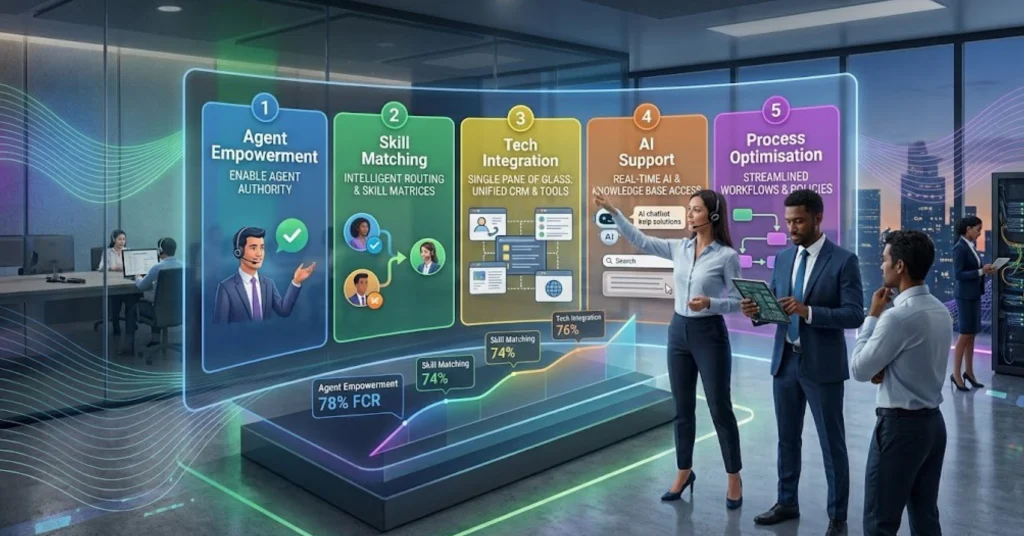
What Are the Five Levers That Actually Improve FCR?
How Does Agent Authority Level Affect First Contact Resolution?
The single most underdiagnosed cause of low FCR is restricted agent authority. When front-line staff must request supervisor approval to grant refunds, issue credits, or modify subscription parameters, the ticket is forced into an escalation loop. This creates an FCR failure regardless of whether the customer eventually receives their requested resolution. Expanding agent resolution thresholds, such as allowing agents to process refunds up to $200 independently, removes structural bottlenecks and resolves issues on the spot.
How Does Knowledge Base Quality Affect First Contact Resolution?
An agent who cannot quickly locate technical answers during an active session is forced to either provide a generic reply or ask the customer to await a follow-up email. Both outcomes represent clear FCR failures. High-performing support teams integrate their internal knowledge base directly into the ticketing UI. Using AI tools to surface knowledge base documentation inline based on real-time conversation context eliminates search friction and helps agents deliver precise answers immediately.
How Does Channel Context Continuity Affect First Contact Resolution?
When a customer initiates an inquiry via WhatsApp and subsequently follows up through email, a fragmented support stack treats these interactions as separate events. The email agent lacks visibility into the previous WhatsApp history, forcing the customer to repeat their information. Implementing a strategy built around omnichannel customer communication unifies message history into a central thread, eliminating context loss across channels.
How Does Agent Training Affect First Contact Resolution?
Newer support representatives generally record lower FCR rates because they lack the pattern recognition that experienced agents develop over time. Deploying AI copilots during active ticket handling provides new agents with real-time suggestions, recommended workflows, and verified response templates based on historical ticket resolutions. A landmark Stanford-MIT study demonstrated that AI-assisted support agents resolved 15% more issues per hour, with the largest efficiency gains realized by inexperienced workers.
How Does Ticket Routing Affect First Contact Resolution?
Routing a specialized technical dispute to a general tier-1 agent creates a structural FCR failure before the interaction even begins. Smart routing engines evaluate ticket content, customer sentiment, and required authority levels upon intake, automatically directing incoming inquiries to the agent best equipped to handle them. Optimized assignment logic reduces internal transfers and raises first-touch resolution rates immediately.
What Does a Low-FCR Operation Look Like vs a High-FCR One?
To understand how operational decisions impact first contact resolution, consider two organizations of identical scale: 10 support agents handling 500 total incoming tickets daily.
| Operational Metric | Low-FCR Operation | High-FCR Operation |
| Overall FCR Rate | 52% | 81% |
| Agent Refund Authority | Requires supervisor approval | Agents resolve up to $200 independently |
| Knowledge Base Access | Separate browser tab / manual search | Surfaced inline by AI Copilot |
| Channel History Visibility | Disconnected across channels | Full history across WhatsApp, Email, and SMS |
| Ticket Routing Logic | First available agent | Matched by ticket type and agent skill |
| Follow-Up Contact Rate | 48% of tickets require a second contact | 19% of tickets require a second contact |
| Daily Repeat Contacts | 240 repeat contacts per day | 95 repeat contacts per day |
| Daily Handling Cost of Repeats | $3,240 (at $13.50 per contact) | $1,282 (at $13.50 per contact) |
| Average CSAT Score | 61 | 82 |
Closing the operational gap from a 52% FCR to an 81% FCR reduces daily repeat contacts from 240 down to 95. At an industry-standard handling cost of $13.50 per agent-assisted interaction, eliminating 145 repeat tickets daily saves $1,957.50 per day. This equates to $58,725 in direct monthly savings, or $704,700 saved annually through structural FCR optimization alone.
What Is the Real Cost of a Low First Contact Resolution Rate? A Calculated Breakdown
The financial damage caused by a low FCR rate scales directly with overall support volume. Using Gartner’s benchmark cost of $13.50 per agent-assisted contact, the following calculations demonstrate the precise cost of unresolved initial interactions across small, medium, and large operations.
Key Financial Callout:
A self-service contact costs $1.84. An agent-assisted contact costs $13.50. For a team handling 10,000 tickets per month at 70% FCR, the 3,000 follow-up contacts cost $40,500 in additional handling costs every month.
Small Support Operation (50 Tickets Daily)
- Current State: 50 daily tickets operating at a 65% FCR.
- Daily First-Contact Resolutions: 32.5 tickets resolved immediately.
- Daily Repeat Contacts Generated: 17.5 follow-up tickets per day.
- Daily Handling Cost of Repeats: $17.5 \times \$13.50 = \$236.25$
- Monthly Cost of Repeats: $\$236.25 \times 30 = \$7,087.50$
- Annual Cost of Repeats: $\$7,087.50 \times 12 = \$85,050$
- Financial Impact of Improvement: Increasing FCR from 65% to 75% eliminates 5 repeat contacts per day, saving $67.50 daily or $24,637.50 annually.
Medium Support Operation (500 Tickets Daily)
- Current State: 500 daily tickets operating at a 70% FCR.
- Daily Repeat Contacts Generated: 150 follow-up tickets per day.
- Daily Handling Cost of Repeats: $150 \times \$13.50 = \$2,025$
- Monthly Cost of Repeats: $\$2,025 \times 30 = \$60,750$
- Annual Cost of Repeats: $\$60,750 \times 12 = \$729,000$
- Financial Impact of Improvement: Increasing FCR from 70% to 80% eliminates 50 repeat contacts per day, saving $675 daily or $246,375 annually.
Large Support Operation (5,000 Tickets Daily)
- Current State: 5,000 daily tickets operating at a 70% FCR.
- Daily Repeat Contacts Generated: 1,500 follow-up tickets per day.
- Daily Handling Cost of Repeats: $1,500 \times \$13.50 = \$20,250$
- Monthly Cost of Repeats: $\$20,250 \times 30 = \$607,500$
- Annual Cost of Repeats: $\$607,500 \times 12 = \$7,290,000$
- Financial Impact of Improvement: Increasing FCR from 70% to 80% eliminates 500 repeat contacts per day, saving $6,750 daily or $2,463,750 annually.
The expenses tied to low first contact resolution are not unchangeable operational costs; they represent recoverable capital that can be reclaimed by addressing the root causes of repeat contacts.
How Do You Diagnose Where Your FCR Is Leaking?
1.Calculate actual FCR using the 7-day window method:Standardize your measurement period.
Pull all support tickets closed over the last 30 days from your CRM. Cross-reference customer IDs to flag any customer who submitted a second ticket regarding the same issue within 7 days of ticket closure. Divide the unflagged resolved tickets by the total tickets handled, then multiply by 100. Most teams find their true 7-day FCR rate is 8 to 15 percentage points lower than the native metrics reported by their ticketing software, which often measure first response rather than true issue resolution.
2.Break FCR down by specific ticket category:Identify target areas for high-impact fixes.
An overall team FCR of 70% often masks severe disparities between ticket categories, such as a 90% FCR on password resets paired with a 45% FCR on shipping adjustments. Tag your last 200 re-contact tickets by category. Identify the single ticket type generating the highest volume of follow-ups. Focus your immediate optimization efforts on resolving bottlenecks within that single category before attempting broad adjustments elsewhere.
3.Analyze root causes of re-contacts:Separate structural limits from agent training needs.
Sample 20 original interactions from your highest-failure ticket category and review them thoroughly. Evaluate whether the front-line agent had the authority, information, and software tools necessary to achieve first contact resolution during the initial interaction. If the agent lacked system access or refund authority, the failure is structural and requires operational changes. If the agent possessed full authority but missed established procedures, the failure requires coaching and updated documentation.
4.Audit cross-channel contact fragmentation:Quantify cross-channel customer follow-ups.
Identify how many repeat contacts entered through a different channel than the original message (e.g., a WhatsApp message followed by an email). If your channels operate in silos without shared conversation history, cross-channel inquiries force customers to repeat themselves, triggering unnecessary FCR failures. Connecting incoming communication streams into a shared team inbox resolves this source of ticket inflation.
5.Establish a 90-day tracking cadence:Monitor progress using weekly category reviews.
Set a target to increase overall FCR by 5 percentage points over a 90-day period. Review category-level FCR metrics weekly rather than relying on monthly high-level averages. Weekly audits catch sudden regressions in specific ticket types early, allowing team leads to update knowledge resources and routing rules before minor issues impact monthly performance targets.
Frequently Asked Questions
What is the first contact resolution?
First contact resolution is the percentage of customer support issues resolved during the first interaction without the customer needing to follow up about the same problem. It is calculated by dividing the number of issues resolved on first contact by the total issues handled, multiplied by 100. The cross-industry average FCR rate in 2026 is 70%, according to SQM Group benchmarking data. A score of 75% or above is considered good for most industries, and 80% or above is classified as world-class.
What is a good first contact resolution rate in 2026?
A good first contact resolution rate for most industries in 2026 is 75% or above, with 80% representing world-class performance according to SQM Group. Retail and e-commerce achieve the highest average FCR at 78% and 75% to 85% respectively, due to simpler, more bounded ticket types. Healthcare and financial services fall in the 65% to 75% range due to regulatory verification requirements. Telecom consistently records the lowest FCR of any major industry because many issues require back-end system access agents cannot complete in a single interaction.
What is the first contact resolution formula?
The first contact resolution formula is: FCR equals the number of issues resolved on first contact, divided by the total number of issues handled, multiplied by 100. The key measurement decision is the follow-up window. The industry standard is 7 days: if a customer contacts the business again about the same issue within 7 days of the original ticket closing, the original ticket is reclassified as an FCR failure. Teams that use a shorter window or no window at all consistently overstate their FCR rate by 8 to 15 percentage points.
How does first contact resolution affect CSAT?
Every 1% improvement in first contact resolution produces a 1% improvement in CSAT score, according to SQM Group research. Every repeat contact a customer makes about the same issue drops their satisfaction by 15%. This 1-to-1 relationship makes FCR the single most powerful operational lever for improving CSAT, more direct and more measurable than response time, channel choice, or agent tone. 96% of customers who experience high-effort interactions, meaning they had to follow up, become disloyal according to Gartner.
What is the cost of low first contact resolution?
The cost of low FCR is calculated using Gartner’s published cost-per-contact benchmarks: $13.50 per agent-assisted contact versus $1.84 for self-service. For a team handling 10,000 tickets per month at 70% FCR, the 3,000 follow-up contacts cost $40,500 in additional handling costs every month. At 500 daily tickets and 70% FCR, the annual cost of repeat contacts is $729,000. Every 1 percentage point improvement in FCR reduces that annual cost by approximately $24,600 at this volume.
What causes low first contact resolution?
Low FCR has five structural causes. First, agents lack the authority to resolve issues without escalation or supervisor approval, which guarantees a follow-up regardless of agent skill. Second, knowledge base gaps mean agents cannot find answers during a live interaction and ask customers to wait for a follow-up. Third, disconnected channels mean a customer who follows up on a different channel is treated as a new contact with no prior history. Fourth, poor routing sends complex tickets to agents without the skill or authority to resolve them. Fifth, AI that deflects rather than resolves generates follow-up contacts that register as FCR failures without the original deflection being counted.
How do you improve first contact resolution rate?
Five levers improve FCR in order of impact. Expanding agent resolution authority on high-volume ticket types removes structural escalation barriers. Connecting an AI copilot that surfaces knowledge base articles inline during live conversations eliminates the tab-switching that causes agents to close tickets unresolved. Unifying all channels in a shared inbox eliminates cross-channel re-contacts where customers repeat themselves on a second channel. Smart routing that matches ticket type to agent skill prevents misrouted tickets from generating structural re-contacts. Training agents on the most common follow-up reasons for each ticket type closes the pattern recognition gap that causes newer agents to underperform on FCR.
How is first contact resolution different from first response time?
First response time measures how quickly an agent replies to a customer’s first message. First contact resolution measures whether the customer’s issue was fully resolved in that first interaction without a follow-up. A fast first response time does not contribute to FCR unless the issue was also resolved in that same interaction. Teams that optimize for first response time at the expense of resolution quality consistently see low FCR because agents close tickets quickly with generic or partial answers to meet their response time target.